PixelLoop: Shortcut Topological Navigation with Pixel-Level Loops

Accepted at IEEE/RSJ IROS 2026
Corresponding Author
Robotics Research Centre IIIT Hyderabad
Teaser for PixelLoop

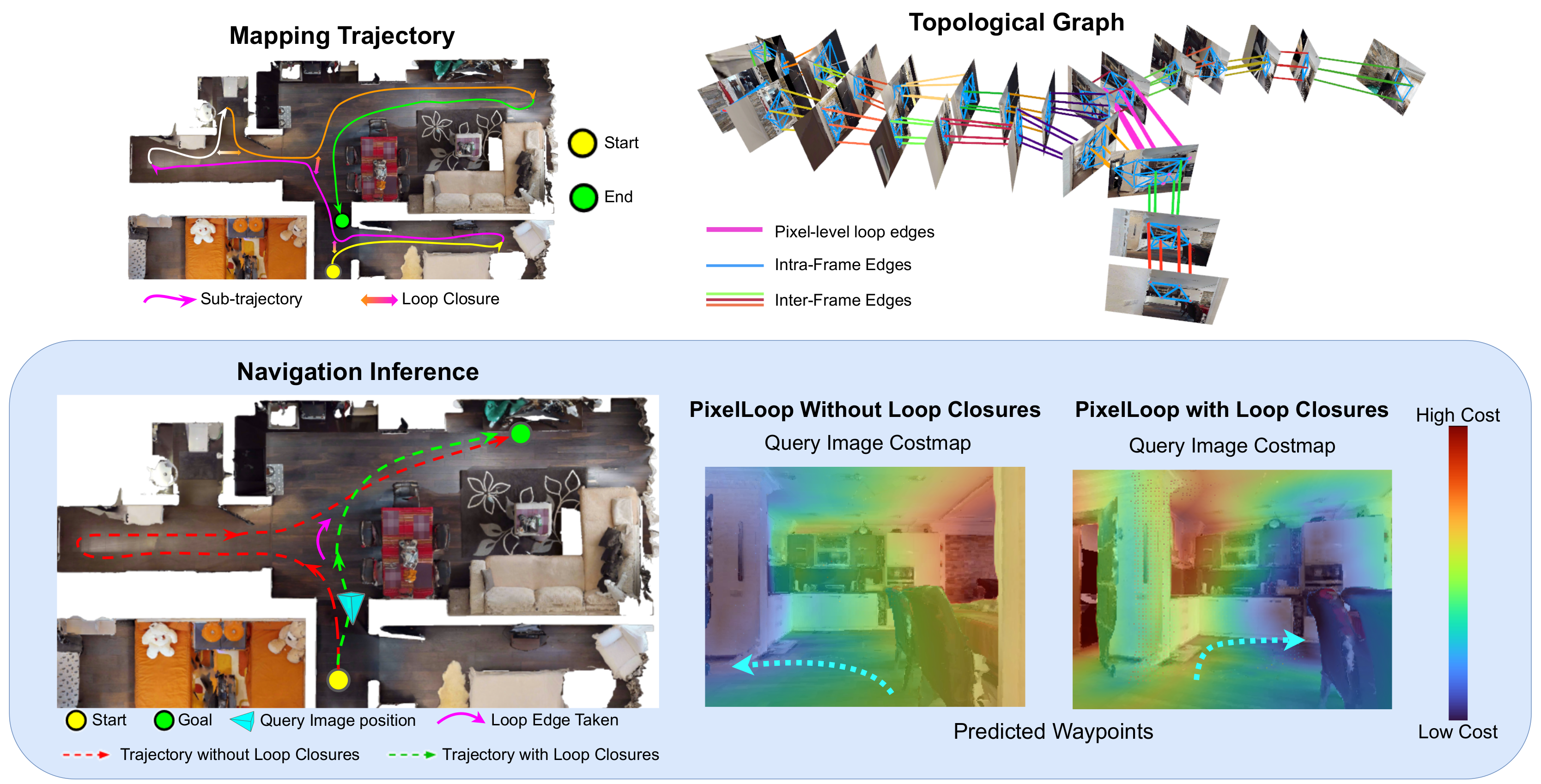
PixelLoop connects sparse image nodes with dense pixel-level loop closures, generating high-quality topological shortcuts for stable robot navigation.

Abstract

Although topological mapping and navigation have been studied extensively, the specific role and downstream effect of loop closures in purely topological representations has received relatively little attention. Importantly, loop closure over topological maps is distinct from loop closure over globally referenced trajectories and metric maps.

Building on recent denser topologies grounded in pixel-level, relative 3D geometry, we propose PixelLoop which introduces loop closures directly in pixel space. Unlike sparse image-level edges or pose-graph corrections in SLAM, our pixel-level closures act as dense topological shortcuts that alter planning connectivity and cost propagation rather than merely aligning coordinates. This dense connectivity enables stable any-point-to-any-point navigation and produces costmaps that align accurately with geometric shortest paths.

In particular, we showcase the distinct advantage of applying loop closures to fine-grained pixel topologies rather than image-level topologies. Across extensive simulated experiments, PixelLoop achieves over 35% absolute improvement in both Success Rate and SPL compared to image-relative baselines, with the largest gains in scenarios requiring shortcut exploitation. Results are further validated through real-world mobile robot deployments, demonstrating that dense pixel-level loop closures provide a practical and robust foundation for topological visual navigation.

Project Video

Methodology

PixelLoop Pipeline

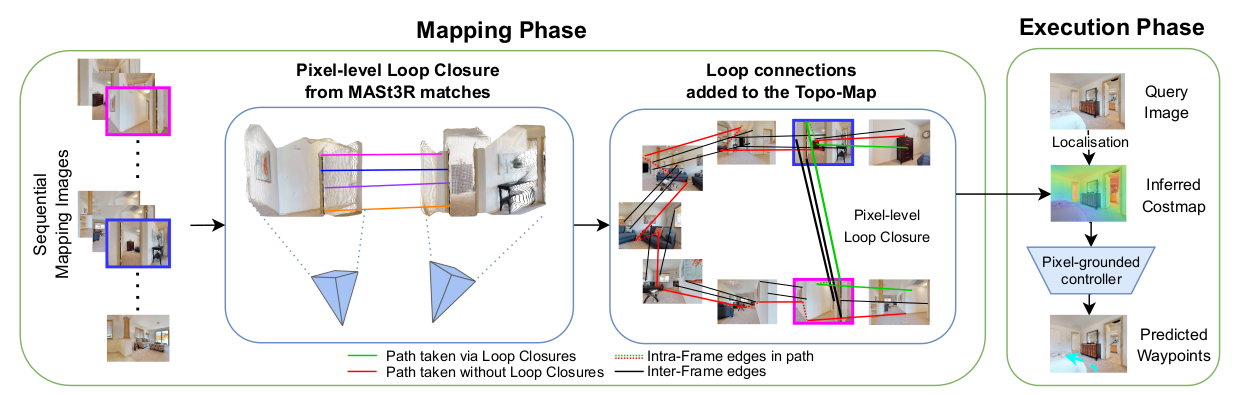
In PixelLoop, we build an arbitrary start-to-goal navigation stack utilizing a 3D relative mapping representation. Our framework is built upon MASt3R-Nav, leveraging dense pixel correspondences to construct a relative-geometry grounded topological graph.

To expand beyond simple teach-and-repeat trajectories, we propose:

  • Loop Detection: We identify temporally distant but geometrically overlapping views using SeqVLAD to find sequence-level candidate matches. We verify them through a bidirectional covisibility evaluation using UniFlowMatch (UFM).
  • Pixel-level Loop Closures: Rather than modifying global metric maps mathematically or providing discrete image-node jumps, we insert these loops as zero-cost edges between densely grounded 3D pixel nodes across image pairs.

During execution, matching a query observation against this interconnected topological graph seamlessly stitches overlapping regions into a unified spatial manifold. This produces dense structured costmaps for shorter optimal paths and conditions a learned controller for waypoint prediction.

Quantitative Results

We evaluate PixelLoop along two axes: the quality of its dense planning costmaps and the downstream navigation performance enabled by pixel-level loop closures.

Planning costmap quality across mapping images

We first evaluate whether pixel-level loop closures improve the quality of the dense planning costmaps themselves. We compare predicted costs against geodesic distances from the navigation mesh and against costmaps generated using ground-truth pixel correspondences.

Predicted cost MAE over the minimum k% predicted cost pixels; lower is better.

Loop Source Geodesic / Navigation Mesh-Based Costmaps Ground Truth Pixel Correspondences
Mean MAE ↓ Median MAE ↓ Mean MAE ↓ Median MAE ↓
5%15%30%50% 5%15%30%50% 5%15%30%50% 5%15%30%50%
GT-Covisibility 0.0880.2260.3610.408 0.0990.2590.3690.385 0.0730.1740.2620.299 0.0810.1740.2460.269
None 0.0900.2390.3870.441 0.1000.2790.4150.427 0.0780.1920.2960.337 0.0880.2000.2850.309
SeqVLAD + UFM 0.0870.2260.3610.409 0.0990.2600.3700.382 0.0730.1770.2700.308 0.0820.1780.2560.279

Navigation performance across 73 simulated start-to-goal tasks

We benchmark PixelLoop against image-level (GNM) and object-level (ObjectReact) loop closure strategies under identical experimental settings. Incorporating pixel-level loop closures yields substantial improvements across all metrics, achieving significant absolute improvements in Success Rate (SR) and Success weighted by Path Length (SPL) without sacrificing performance.

Method Loop Source SR ↑ SPL-S ↑ SPL-A ↑ SSPL ↑
PixelLoop (Ours) GT-Covisibility54.7991.7050.2558.39
None35.6280.4528.6540.70
SeqVLAD + UFM68.4991.1562.4373.97
GNM (HM3D) GT-Covisibility24.6670.5017.3818.40
None20.5564.8013.3215.95
SeqVLAD + UFM27.4076.9721.0922.44
GNM-Adapted (HM3D) GT-Covisibility32.8883.5627.4728.01
None17.8175.2813.4116.95
SeqVLAD + UFM32.8883.9727.6128.56
ObjectReact GT-Covisibility63.0165.2141.0965.91
None58.9063.2137.2338.77
SeqVLAD + UFM67.1269.3746.8268.35

Qualitative Results

More qualitative results coming soon!

BibTeX

@inproceedings{chittawar2026pixelloop,
  title={PixelLoop: Shortcut Topological Navigation with Pixel-Level Loops},
  author={Chittawar, Sarthak and Garg, Vansh and Vadali, Aditya and Pandya, Krish and Jayanti, Rohit and Garg, Sourav and Krishna, K Madhava},
  booktitle={Proceedings of the IEEE/RSJ International Conference on Intelligent Robots and Systems (IROS)},
  year={2026}
}